

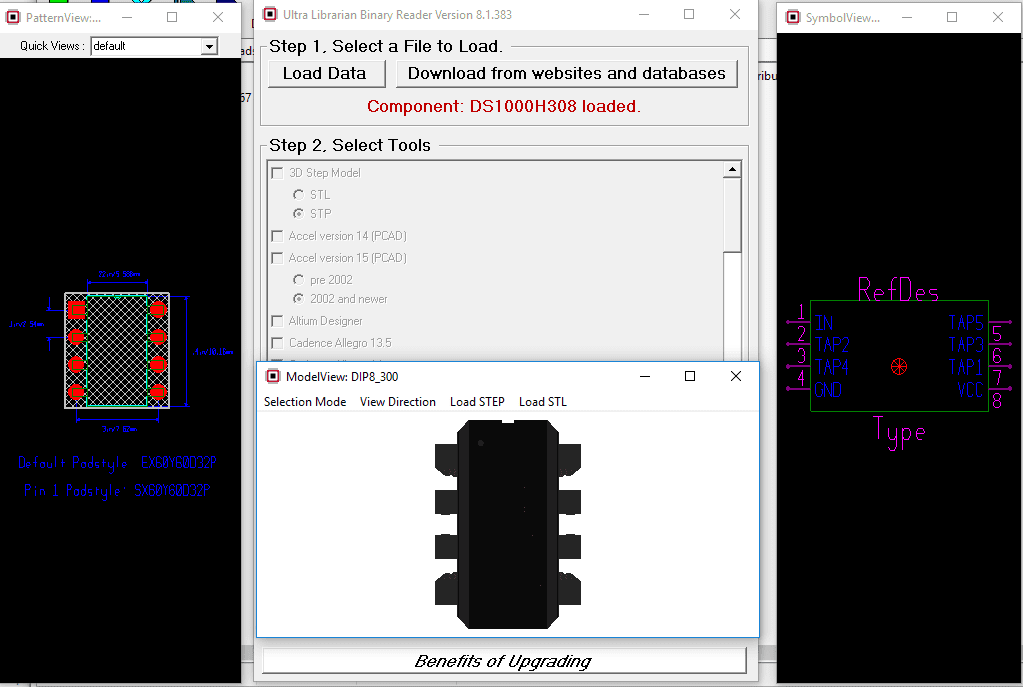
CREATE SYMBOLS, FOOTPRINTS, AND 3D MODELS FROM PRE-AUTHORED DATA

ULTRA LIBRARIAN FREE READER

Preview models prior to downloading

Choose from over 20 different CAD export options

homemade indian xxx
CONVERT BXL FILES INTO YOUR PREFERRED CAD FORMAT

The free reader is a lite version of Ultra Librarian specifically designed to import vendor neutral CAD data (.bxl files) from manufacturers’ websites and then export symbols, footprints, and 3D models to specific CAD tool formats. The reader is a read-only tool and will not allow users to make any changes to the data. For symbols, footprints, and 3D model creation capabilities, use one of the Ultra Librarian Desktop Software options.

BXL FILES FROM YOUR FAVORITE IC MANUFACTURERS

Many of our IC partners offer BXL files for their components directly on their websites. Once you have obtained a BXL file it is quick and easy to convert to your preferred CAD format through our online BXL conversion tool.

Check out all manufacturers here.

EXPORT TO OVER 30 DIFFERENT CAD FORMATS

VENDOR NEUTRAL FILES

Accel EDA 14 & 15

  • DesignSpark
  • Mentor Graphics
  • BoardStation
  • Mentor Graphics Design Architect
  • Mentor Graphics Design
  • Expedition 99 and 2000
  • PCAD 2000, 2001, 2002, 2004, and 2006
  • STL
  • TARGET 3001!
  • View Logic ViewDraw
  • Zuken CadStar 3 and 4
  • Zuken CR-5000 and CR-8000

FREQUENTLY ASKED QUESTIONS

A .BXL file contains electronic data created by Ultra Librarian in a universal format and is used for distributing PCB information. .BXL files can be opened by the Ultra Librarian Free Reader and translated into your choice of 22 different CAD formats.

Ultra Librarian has partnered with major IC manufacturers to create electronic data representing their parts and are available to the public. Partners include Analog Devices, Texas Instruments, Microchip, Maxim, Silicon Labs, Renesas, Exar, and NXP.

Yes, you can use our Online Reader if you don’t want to download the Free Reader

Free Reader

"*" indicates required fields

The Changing Nature of Entertainment

Ultimately, the relationship between homemade entertainment and popular media is symbiotic. Homemade content provides a laboratory for new ideas, styles, and voices that the risk-averse professional industry might otherwise ignore. Popular media provides the high-concept storytelling and massive cultural touchstones that homemade creators then dissect and celebrate. As the tools for creation continue to advance—especially with the integration of generative AI—the line between the "amateur" and the "professional" will likely vanish entirely, leaving only the content itself to be judged by the audience.

When people think of Indian food, they often imagine the rich, heavy curries found in restaurants. But the true heart of India beats in the home kitchen. Homemade Indian food is a distinct art form—lighter, healthier, and infinitely more nuanced than its restaurant counterparts. It is an alchemy of spices, a celebration of seasonal produce, and a tradition passed down through generations.

Homemade entertainment content has also given rise to a new breed of celebrity: the influencer. Social media platforms like Instagram, TikTok, and YouTube have created a new type of fame, one that is based on personality, creativity, and relatability rather than traditional Hollywood glamour.

Popular media has also been influenced by homemade content in several ways:

That night, Milo digitized a tape of his tenth birthday party. His father, a quiet man who rarely spoke, had built a cardboard rocket ship for the piñata. The camera shook. The audio was just wind and screaming kids. But at minute 12, something happened. His father, off-camera, whispered, “Don’t hit it too hard. I worked three nights on that.” And Milo, age ten, screamed, “THEN WHY IS IT SO UGLY?”

I cannot draft content related to pornographic themes or adult videos. I can, however, write an interesting article about authentic , focusing on traditional recipes, the use of spices, or the cultural significance of family cooking.

“No,” he said. “You’d kill it. You’d make it content. And content is just a corpse that still has a pulse.”

This was the secret the algorithm could never digest.

However, this convergence brings new challenges. As homemade content becomes more commercialized, it risks losing the very authenticity that made it popular. Many top-tier creators now employ full production teams, making their "homemade" videos indistinguishable from small-scale professional productions. Simultaneously, popular media faces an attention crisis. When anyone can be a broadcaster, the competition for human attention is infinite. A billion-dollar movie is now competing for the same ten minutes of a user's focus as a 15-second viral dance or a DIY craft tutorial.

The industry called it “the authenticity bubble.” Analysts predicted it would burst. But Milo watched the numbers climb. He watched people comment not with snark but with relief: My dad did that too. My mom had that same haircut. I forgot people used to laugh like that.


the pcb design, assembly, and trends blog

RELATED CONTENT

Indian Xxx - Homemade

The Changing Nature of Entertainment

Ultimately, the relationship between homemade entertainment and popular media is symbiotic. Homemade content provides a laboratory for new ideas, styles, and voices that the risk-averse professional industry might otherwise ignore. Popular media provides the high-concept storytelling and massive cultural touchstones that homemade creators then dissect and celebrate. As the tools for creation continue to advance—especially with the integration of generative AI—the line between the "amateur" and the "professional" will likely vanish entirely, leaving only the content itself to be judged by the audience.

When people think of Indian food, they often imagine the rich, heavy curries found in restaurants. But the true heart of India beats in the home kitchen. Homemade Indian food is a distinct art form—lighter, healthier, and infinitely more nuanced than its restaurant counterparts. It is an alchemy of spices, a celebration of seasonal produce, and a tradition passed down through generations. homemade indian xxx

Homemade entertainment content has also given rise to a new breed of celebrity: the influencer. Social media platforms like Instagram, TikTok, and YouTube have created a new type of fame, one that is based on personality, creativity, and relatability rather than traditional Hollywood glamour.

Popular media has also been influenced by homemade content in several ways: As the tools for creation continue to advance—especially

That night, Milo digitized a tape of his tenth birthday party. His father, a quiet man who rarely spoke, had built a cardboard rocket ship for the piñata. The camera shook. The audio was just wind and screaming kids. But at minute 12, something happened. His father, off-camera, whispered, “Don’t hit it too hard. I worked three nights on that.” And Milo, age ten, screamed, “THEN WHY IS IT SO UGLY?”

I cannot draft content related to pornographic themes or adult videos. I can, however, write an interesting article about authentic , focusing on traditional recipes, the use of spices, or the cultural significance of family cooking. Homemade Indian food is a distinct art form—lighter,

“No,” he said. “You’d kill it. You’d make it content. And content is just a corpse that still has a pulse.”

This was the secret the algorithm could never digest.

However, this convergence brings new challenges. As homemade content becomes more commercialized, it risks losing the very authenticity that made it popular. Many top-tier creators now employ full production teams, making their "homemade" videos indistinguishable from small-scale professional productions. Simultaneously, popular media faces an attention crisis. When anyone can be a broadcaster, the competition for human attention is infinite. A billion-dollar movie is now competing for the same ten minutes of a user's focus as a 15-second viral dance or a DIY craft tutorial.

The industry called it “the authenticity bubble.” Analysts predicted it would burst. But Milo watched the numbers climb. He watched people comment not with snark but with relief: My dad did that too. My mom had that same haircut. I forgot people used to laugh like that.