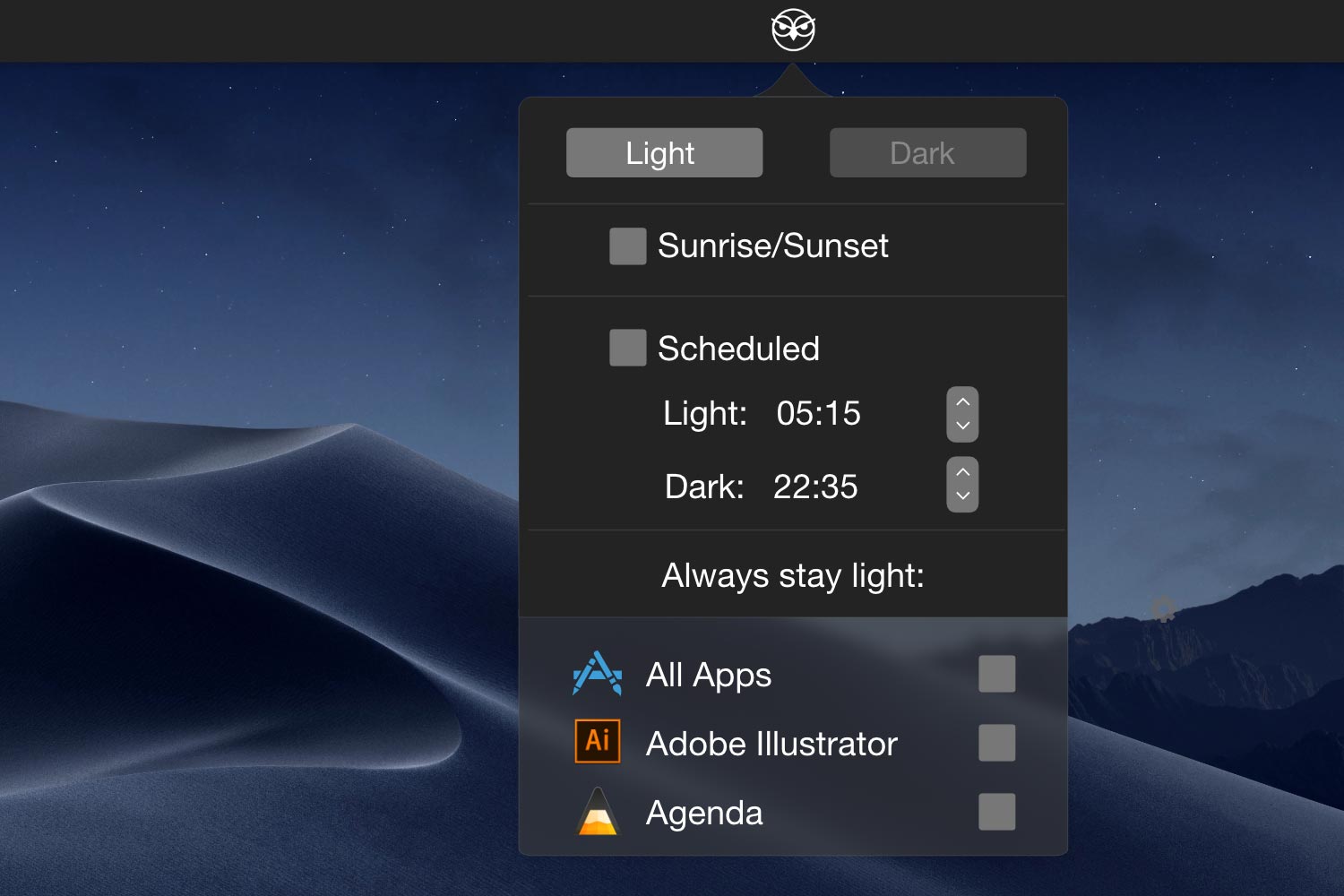
NightOwl will toggle the Dark/Light Modes based on your chosen time. You only have to set it up once, then it will run in the background.
Want your Mac to be in Dark Mode during night and switched back to Light Mode, when the sun rises? NightOwl does the work for you.
It only takes you a second to switch between Mojaves Dark/Light Modes by using the Hotkeys. Press, "Huuhuuhhh", dark. - that easy
In the mid-1990s, the American Association of Motor Vehicle Administrators (AAMVA) faced a problem. Every state issued driver’s licenses, but none of them talked to each other. A cop in Nevada pulling over a driver from Maine had no quick way to verify if that Maine license was real or a forgery.
Many countries and states use PDF417 barcodes on driver's licenses and identification cards to store personal data, such as:
The PDF417 barcode transformed the plastic driver’s license from a simple visual ID into a machine-readable data file. As we move toward Mobile Driver’s Licenses (mDLs), the data structures pioneered by the PDF417 standard continue to serve as the backbone for identity verification. pdf417 drivers license
At first glance, it’s an eyesore. A blocky, rectangular patch of black and white hieroglyphics plastered on the back of your driver’s license. Unlike the sleek, minimalist QR codes that advertise craft beer websites, the PDF417 looks like something left over from a 1990s dot-matrix printer.
You never see this happen. The officer doesn’t type a single keystroke. That is the genius of PDF417: it shifts verification from a slow, error-prone manual process to an instant, automated one. In the mid-1990s, the American Association of Motor
Here are a few options for a post regarding "PDF417 Driver’s Licenses," tailored to different audiences (Technical/Educational vs. General Audience vs. Social Media).
But the mDL transition will take a decade. Until then, every plastic card in your wallet will carry that ugly, blocky, brilliant PDF417 on the back. Many countries and states use PDF417 barcodes on
The use of PDF417 barcodes on driver's licenses offers several benefits:
In less than a third of a second:
PDF417 barcodes on driver's licenses are typically read using a barcode reader or a mobile device with a camera and barcode scanning software. The reader decodes the barcode and displays the encoded data, which can be verified against the license holder's physical identification.
And it does it all in 1.1 kilobytes.
In the mid-1990s, the American Association of Motor Vehicle Administrators (AAMVA) faced a problem. Every state issued driver’s licenses, but none of them talked to each other. A cop in Nevada pulling over a driver from Maine had no quick way to verify if that Maine license was real or a forgery.
Many countries and states use PDF417 barcodes on driver's licenses and identification cards to store personal data, such as:
The PDF417 barcode transformed the plastic driver’s license from a simple visual ID into a machine-readable data file. As we move toward Mobile Driver’s Licenses (mDLs), the data structures pioneered by the PDF417 standard continue to serve as the backbone for identity verification.
At first glance, it’s an eyesore. A blocky, rectangular patch of black and white hieroglyphics plastered on the back of your driver’s license. Unlike the sleek, minimalist QR codes that advertise craft beer websites, the PDF417 looks like something left over from a 1990s dot-matrix printer.
You never see this happen. The officer doesn’t type a single keystroke. That is the genius of PDF417: it shifts verification from a slow, error-prone manual process to an instant, automated one.
Here are a few options for a post regarding "PDF417 Driver’s Licenses," tailored to different audiences (Technical/Educational vs. General Audience vs. Social Media).
But the mDL transition will take a decade. Until then, every plastic card in your wallet will carry that ugly, blocky, brilliant PDF417 on the back.
The use of PDF417 barcodes on driver's licenses offers several benefits:
In less than a third of a second:
PDF417 barcodes on driver's licenses are typically read using a barcode reader or a mobile device with a camera and barcode scanning software. The reader decodes the barcode and displays the encoded data, which can be verified against the license holder's physical identification.
And it does it all in 1.1 kilobytes.
141k +
27k+
6.3M +