
CREATE SYMBOLS, FOOTPRINTS, AND 3D MODELS FROM PRE-AUTHORED DATA

ULTRA LIBRARIAN FREE READER

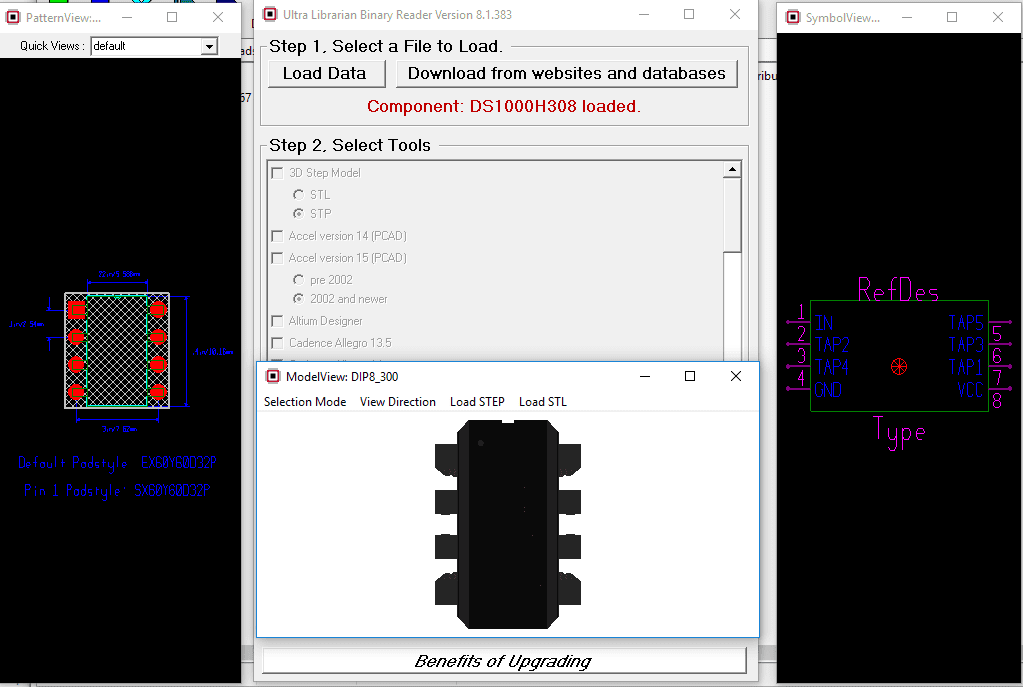
Preview models prior to downloading

Choose from over 20 different CAD export options

python zero to mastery udemy
CONVERT BXL FILES INTO YOUR PREFERRED CAD FORMAT

The free reader is a lite version of Ultra Librarian specifically designed to import vendor neutral CAD data (.bxl files) from manufacturers’ websites and then export symbols, footprints, and 3D models to specific CAD tool formats. The reader is a read-only tool and will not allow users to make any changes to the data. For symbols, footprints, and 3D model creation capabilities, use one of the Ultra Librarian Desktop Software options.

BXL FILES FROM YOUR FAVORITE IC MANUFACTURERS

Many of our IC partners offer BXL files for their components directly on their websites. Once you have obtained a BXL file it is quick and easy to convert to your preferred CAD format through our online BXL conversion tool.

Check out all manufacturers here.

EXPORT TO OVER 30 DIFFERENT CAD FORMATS

VENDOR NEUTRAL FILES

Accel EDA 14 & 15

  • DesignSpark
  • Mentor Graphics
  • BoardStation
  • Mentor Graphics Design Architect
  • Mentor Graphics Design
  • Expedition 99 and 2000
  • PCAD 2000, 2001, 2002, 2004, and 2006
  • STL
  • TARGET 3001!
  • View Logic ViewDraw
  • Zuken CadStar 3 and 4
  • Zuken CR-5000 and CR-8000

FREQUENTLY ASKED QUESTIONS

A .BXL file contains electronic data created by Ultra Librarian in a universal format and is used for distributing PCB information. .BXL files can be opened by the Ultra Librarian Free Reader and translated into your choice of 22 different CAD formats.

Ultra Librarian has partnered with major IC manufacturers to create electronic data representing their parts and are available to the public. Partners include Analog Devices, Texas Instruments, Microchip, Maxim, Silicon Labs, Renesas, Exar, and NXP.

Yes, you can use our Online Reader if you don’t want to download the Free Reader

Free Reader

"*" indicates required fields

Zara followed along. Her app worked. She typed in “London” and saw “15°C, cloudy.” She typed in “Tokyo” and saw “22°C, clear sky.” She felt like a god.

She built a BankAccount class. Then a Customer class that contained a list of BankAccount objects. Then a Transaction class that recorded deposits and withdrawals with timestamps. She ran it. No errors. She added a method that calculated interest. She added a __str__ method so printing an account showed a human-readable balance. She added a class variable for the bank’s name that all instances shared.

She opened the OpenWeatherMap documentation. It was 200 pages. She spent an hour trying to figure out the API endpoint for forecasts. She spent another hour parsing the JSON response, which was a nested monstrosity of lists and dictionaries. She accidentally made 400 API requests in five minutes while debugging and got rate-limited.

titles = soup.find_all('a', class_='storylink') for title in titles: print(title.text) with open('news.csv', 'a') as file file.write(title.text + '\n')

She understood, suddenly, why people fell in love with Python. It wasn’t just the syntax or the libraries or the community. It was the feeling of turning a messy, real-world problem into something structured and beautiful. Like solving a puzzle where the pieces were made of logic instead of cardboard.

She opened her phone. The Udemy app still had the course in her library. “Python Zero to Mastery.” 100% complete. She left a review: five stars. The review said:

She deployed it to Heroku. She shared it with her study group from the course’s Discord server. Someone found a bug where completing a task after midnight broke the streak. She fixed it with timezone-aware datetimes. Someone else suggested adding tags for tasks. She added a many-to-many relationship and a filter sidebar.

She looked at her code again.

“A class is a blueprint for creating objects,” the instructor said, cheerful as ever.

the pcb design, assembly, and trends blog

RELATED CONTENT

Python Zero To Mastery Udemy [hot] Jun 2026

Zara followed along. Her app worked. She typed in “London” and saw “15°C, cloudy.” She typed in “Tokyo” and saw “22°C, clear sky.” She felt like a god.

She built a BankAccount class. Then a Customer class that contained a list of BankAccount objects. Then a Transaction class that recorded deposits and withdrawals with timestamps. She ran it. No errors. She added a method that calculated interest. She added a __str__ method so printing an account showed a human-readable balance. She added a class variable for the bank’s name that all instances shared.

She opened the OpenWeatherMap documentation. It was 200 pages. She spent an hour trying to figure out the API endpoint for forecasts. She spent another hour parsing the JSON response, which was a nested monstrosity of lists and dictionaries. She accidentally made 400 API requests in five minutes while debugging and got rate-limited. python zero to mastery udemy

titles = soup.find_all('a', class_='storylink') for title in titles: print(title.text) with open('news.csv', 'a') as file file.write(title.text + '\n')

She understood, suddenly, why people fell in love with Python. It wasn’t just the syntax or the libraries or the community. It was the feeling of turning a messy, real-world problem into something structured and beautiful. Like solving a puzzle where the pieces were made of logic instead of cardboard. Zara followed along

She opened her phone. The Udemy app still had the course in her library. “Python Zero to Mastery.” 100% complete. She left a review: five stars. The review said:

She deployed it to Heroku. She shared it with her study group from the course’s Discord server. Someone found a bug where completing a task after midnight broke the streak. She fixed it with timezone-aware datetimes. Someone else suggested adding tags for tasks. She added a many-to-many relationship and a filter sidebar. She built a BankAccount class

She looked at her code again.

“A class is a blueprint for creating objects,” the instructor said, cheerful as ever.