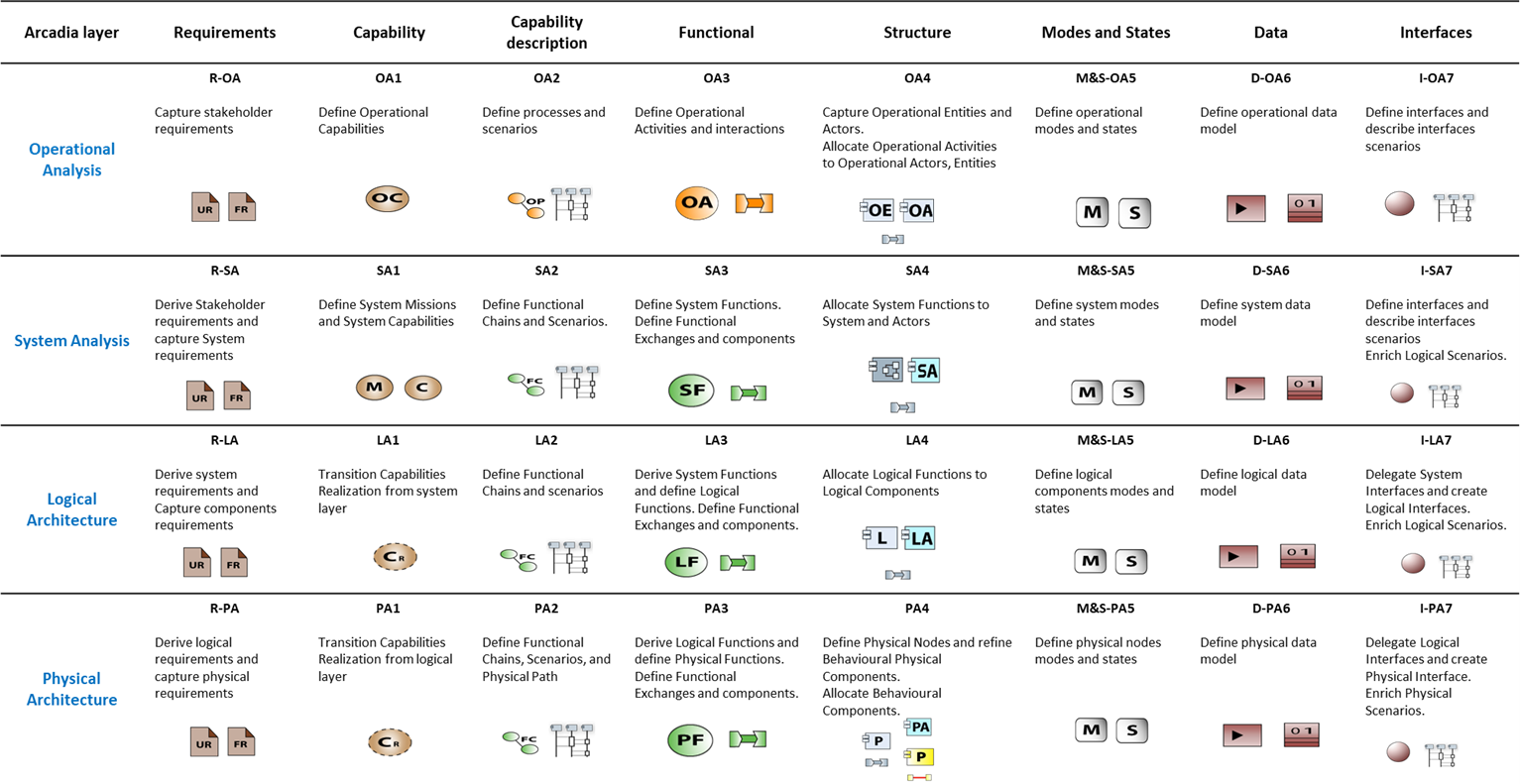
Arcadia is a tooled method devoted to systems & architecture engineering, supported by Capella modelling tool.
It describes the detailed reasoning to
It can be applied to complex systems, equipment, software or hardware architecture definition, especially those dealing with strong constraints to be reconciled (cost, performance, safety, security, reuse, consumption, weight…).
It is intended to be used by most stakeholders in system/product/software or hardware definition and IVVQ as their common engineering reference and collaboration support.
Arcadia stands for ARChitecture Analysis and Design Integrated Approach.
A series of online documents to dive into the principles and concepts of Arcadia:
Arcadia is a system engineering method based on the use of models, with a focus on the collaborative definition, evaluation and exploitation of its architecture.
This book describes the fundamentals of the method and its contribution to engineering issues such as requirements management, product line, system supervision, and integration, verification and validation (IVV). It provides a reference for the modeling language defined by Arcadia.
Jean-Luc Voirin, leader of the creation of the Arcadia method, along with some of the leaders on developing and deploying MBSE Arcadia & Capella practices in Thales. From right to left: Pierre Nowodzienski, Jean-Luc Voirin, Juan Navas, Stephane Bonnet, Frederic Maraux, Gerald Garcia, Philippe Fournies, Eric Lepicier.
Architecture as prime engineering driver
Arcadia, a model-based engineering method
Noticeable features of Arcadia
Definition of the Problem - Customer Operational Need Analysis
Formalization of system requirements - System Need Analysis
Development of System Architectural Design - Logical Architecture (Notional Solution)
Development of System Architecture - Physical Architecture
Formalize Components Requirements - Contracts for Development and IVVQ
Co-Engineering, Sub-Contracting and Multi-Level Engineering
Adaptation of Arcadia to Dedicated Domains, Contexts, Etc.
Equivalences and Differences between SysML and Arcadia/Capella
The summer season in India begins with the Spring equinox but quickly transitions into intense heat. It is the time when the sun is directly overhead the Tropic of Cancer.
Visit in November (late autumn, but technically winter window) or February (end of winter). That is the 5-star window. 3 seasons in india
4/5. You will curse the potholes, but you will miss the thunder when it’s gone. The summer season in India begins with the
F ). Northern India experiences the "Loo"—a hot, dry, and dusty wind that can be dangerous. Highlights: This is the season for mangoes and escaping to hill stations like Shimla or Mussoorie . The Review: It is the most challenging time for sightseeing due to the intense sun, making midday travel nearly impossible in many regions. 2. Monsoon: The Life-Giver (June to September) The arrival of the Southwest Monsoon transforms the parched landscape into a lush green paradise. Weather: Heavy, often unpredictable rain showers and high humidity. While it brings relief from summer heat, it can also lead to urban flooding and travel delays. Highlights: The Western Ghats and the Northeast (like Cherrapunji) are at their most beautiful. It is culturally vital for agriculture and hydroelectric power. The Review: A polarizing season. It’s perfect for nature lovers and "green" tourism, but difficult for those who dislike humidity or disrupted transit. 3. Winter: The Peak Season (October to February) Widely considered the best time to visit India, winter offers the most comfortable conditions for exploration. Weather: Clear blue skies and cool, dry air. North India sees temperatures drop significantly—sometimes below 0 That is the 5-star window