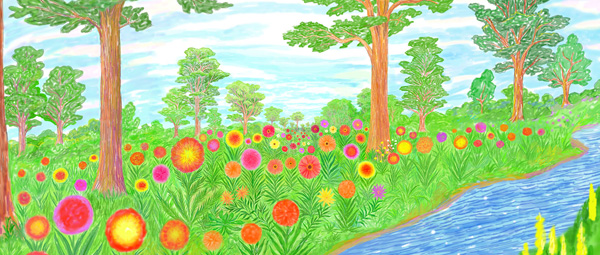
A collaborative infinitely zooming painting
Created in 2004
Up and down keys to navigate
A project by Nikolaus Baumgarten
Participating illustrators: Andreas Schumann, Eero PitkƤnen, Florian Biege, Jann Kerntke, Lars Gƶtze, Luis Felipe, Marcus BlƤttermann, Markus Neidel, Paul Painter, Oliver Schlemmer, Sonja Schneider, Thorsten Wolber, Tony Stanley, Ville Vanninen
Read about the history of this project
Screensaver for Mac

Live Wallpaper for Android
Zoomquilt 2
Arkadia
Infinite Flowers
An Indian Summer is not just a warm day in autumn. It is a return of summer-like conditions after winter has already announced itself.
This high-pressure block alters upper-level wind patterns, effectively deflecting the polar jet stream far to the north. As a result, frigid Arctic air masses are barred from moving southward, while warm, tropical air from southern regions is drawn upward into the temperate zones, trapping the unseasonable warmth for days or even weeks. š Historical Origins and Etymology indian summer'
Derived from folklore regarding ballooning spiders that spin drifting silken webs across fields during calm autumn days. Babye Leto (Grandmother's Summer) An Indian Summer is not just a warm day in autumn
Refers to a final, gracious extension of warm weather allowing low-income households to delay burning winter fuel reserves. š Metaphorical and Literary Signifiers As a result, frigid Arctic air masses are
The term "Indian Summer" is unquestionably of American origin (first recorded in the late 18th century), but its etymology is hotly debated. Theories range from respectful to derogatory:
The evocative nature of a late, fleeting warmth has made "Indian summer" a powerful metaphor across literature, poetry, and everyday idioms. It rarely describes just the weather; instead, it serves as an allegory for human experiences: A Golden Twilight of Life